

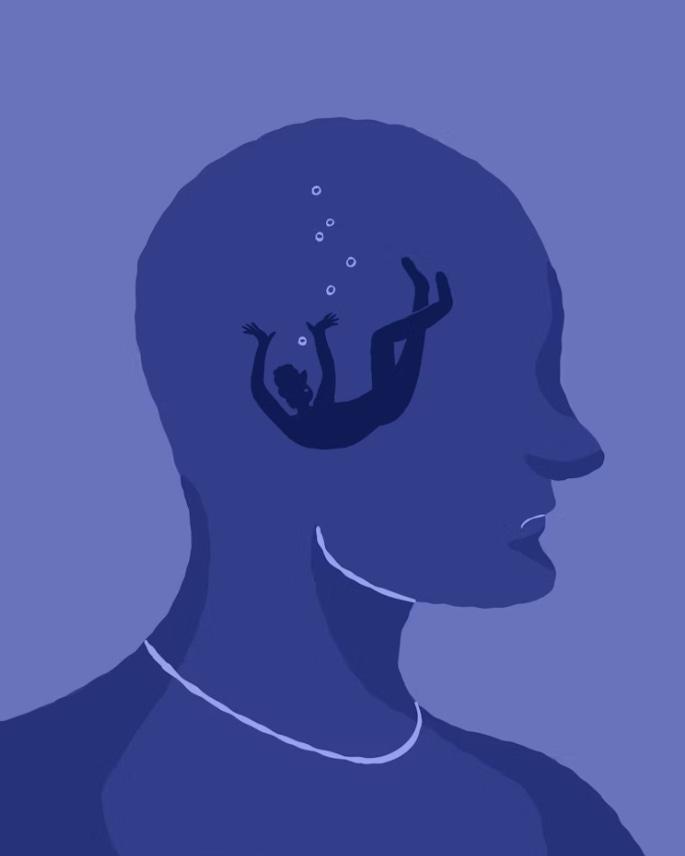
Artwork by Dina Gazizova on Unsplash.
Click, clack, click, clack. Sent.
An hour slips by, then two, three…
Still no reply? Four, five.
Uneasiness creeps into my heart. I stared, eyes fixated on the wall, fingers twitching, absorbed and lost in my own stream of thoughts and feelings. I stared and stared at the wall, trapped in my bubble of maybes and what-ifs. The double blue ticks stared back at me, unwavering. Maybe I’ve said something wrong. Maybe they’re busy.
Thoughts tangle. I unravel. I spiral down
down
down.
As humans, this is normal. We tend to fixate on the bad, the inconveniences, the worst-case scenarios, while discarding all the good things altogether. Rick Hanson, a neuropsychologist and founder of the Wellspring Institute for Neuroscience and Contemplative Wisdom, describes the brain as a ‘Velcro for negative experiences, but Teflon for positive ones’. This phenomenon is known as the ‘negativity bias’, where the brain is lopsided, making it far easier to pick up, store, and recall negative experiences as they are evaluated to have more powerful effects than positive ones of objectively equal magnitude. This can be seen in our everyday lives, where one negative feedback trumps all other positive feedback, where one minor inconvenience ruins our entire mood, and where a single rude comment outweighs a dozen compliments. This is a direct reflection of the negativity bias deeply ingrained into human nature.
Negativity Bias in Early Days
Throughout evolutionary history, organisms were better attuned and highly responsive to immediate threats in their environment. These threats included intertribal conflicts, predatory attacks, and environmental hazards such as prolonged droughts and natural disasters. Hence, the negativity bias functioned as a form of protection; it was, and still is to this day, a survival skill that enables humans to react swiftly to potentially life-threatening situations, often drawing the fine line between life and death. To put it simply, the more attention our ancestors paid to negative stimuli, the greater their chances of survival were in hostile environments. Consequently, this survival ‘instinct’ likely contributed to the transmission of human genes, embedding the negativity bias across generations.
For instance, a person who overlooks the possibility of a positive outcome may only experience regret for having missed an opportunity, such as a job promotion or successfully striking a deal, but nothing directly bad will arise as a result - the most would be disappointment, regret, or possibly self-doubt. In contrast, a person who ignores imminent danger, the possibility of a negative outcome, will likely end up injured or, in the most catastrophic of outcomes, dead. Hence, Daniel Kahneman, an Israeli-American psychologist and economist, observed that ‘organisms that treat threats as more urgent than opportunities have a better chance to survive and reproduce’.
Losses Cut Deeper Than Gains
In the present day, the negativity bias has evolved into a powerful psychological mechanism that fuels and drives human behaviour; it remains one of the most compelling motivators known to mankind. To illustrate this, many of us are familiar with cautionary statements from our parents, such as warnings that failure to study and work hard will result in undesirable outcomes including struggling to secure stable employment and facing socio-economic hardship. These negatively framed, repeated messages exert a stronger psychological impact than positively framed alternatives, such as encouragement that hard work will lead to success. Similarly, it is more effective for a physician to emphasise the risk of developing lung cancer when persuading a smoker to give up smoking, rather than highlighting the many benefits of improved lung health. These illustrations affirm Kahneman’s view that ‘losses loom larger than gains’ when directly compared against each other.
Psychologically, the pain of losing is twice as powerful as the pleasure of gaining; therefore, the way in which an outcome is framed, whether in a positive or negative context, determines how driven we are to complete a specific task. By nature, our motivation and determination are amplified when we are completing a task to avoid a loss rather than to achieve a gain. This phenomenon is also referred to as the ‘loss aversion bias’, where the brain is essentially wired to avoid losses at all costs.
The Social Sting
It is natural for humans to possess an innate desire to belong and be accepted into social groups. Hence, even subtle signs of dislike or exclusion can evoke strong emotional responses. For example, if a friend casually remarks that one’s taste in music is weird or gives a backhanded comment, that split second of a moment is likely to imprint itself deeply into our memory, lingering far longer than a compliment. As a result, we would pay more attention to our perceived shortcomings and develop a desire to hide these perceived flaws. We then become trapped in a perpetuating cycle of bombarding questions at ourselves.
It is then vital to draw the line between being cautious and constantly scrutinising negative memories. Cautiousness is, without a doubt, a good trait to possess; however, when our brains shift from healthy vigilance and tip into the realm of negativity bias, decision-making no longer becomes rooted in logical analysis, but rather influenced by distorted reasoning. This ultimately leads to irrational or poorly thought choices.
Is It All Bad?
It may seem, based on the discussion above, that the negativity bias is a cognitive tendency that we should approach with caution and avoid letting it consume us entirely. However, the negativity bias can, in certain contexts, do us some good. The bias can function as a reinforcement-learning mechanism for us by providing greater sensitivity to punishment, reminding us to avoid similar negative consequences in the future.
In today’s world, society and especially the media often emphasise the maxim and importance of staying positive, promoting optimism through and through, but let’s be real - staying positive all the time is neither realistic nor sustainable. The complexity of human emotion makes suppressing negative feelings in the name of constant positivity counterproductive. Therefore, while the negativity bias is often painted as a flaw, it is far from entirely detrimental. It has been rooted in our evolutionary need to ensure survival, and this bias has served humanity well throughout history, sharpening us in high-stakes situations. Still, the negativity bias may pose risks such as anxiety and distorted perceptions of ourselves if it goes unchecked.
After all, the negativity bias back then was for venomous snakes and woolly mammoths. Today, it is triggered by a side-eye during lunch or a friend who didn’t reply to your message.
6 hours and counting and still no reply…
Written by: Hee Jo Ee
Edited by: Subiksha
P.S. Remember to leave a ❤️ if you’ve enjoyed our articles!